SideWinder APT: Targeted Spear- Phishing Campaign Using Government Lookalike Domains and Remote Template Injection
Published on 23-Nov-2026 14:30:00
Executive Summary
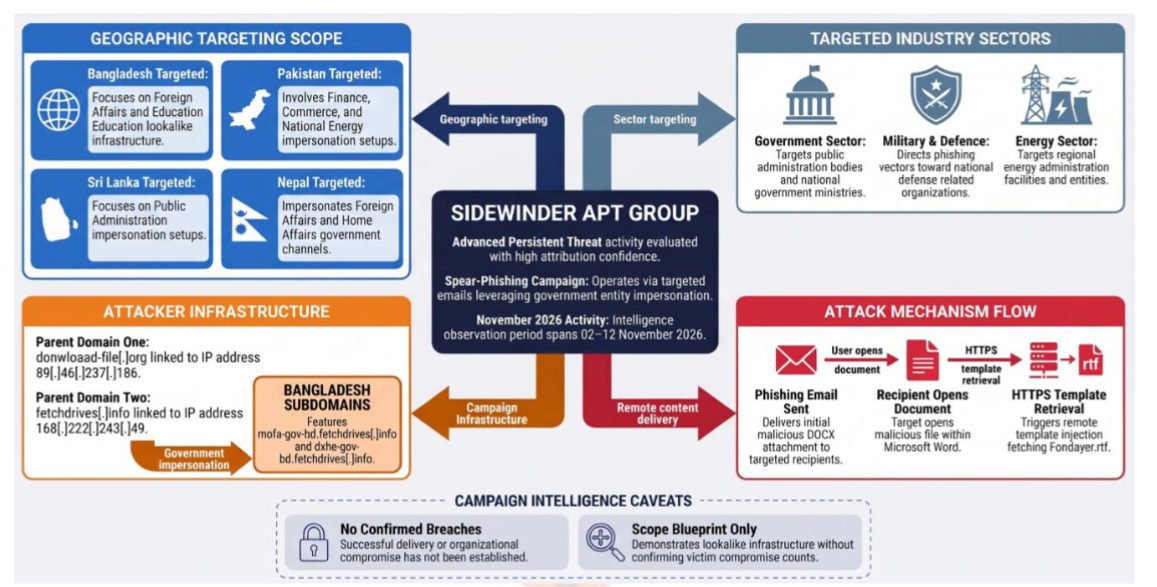
BGD e-GOV CIRT has identified a targeted spear-phishing campaign attributed to the SideWinder APT group, involving the abuse of government-related lookalike domains and weaponised Microsoft Office documents to deliver malicious second-stage content.
The campaign has been observed between 02 November and 12 November 2026. Its targeting includes government and military-related organisations in South and East Asia, with infrastructure impersonating government entities in Bangladesh, Pakistan, Nepal, Sri Lanka and China.
The observed phishing documents impersonate government ministries and institutions, using themes such as pay-scale revisions, travel advisories and official training schedules. The documents are primarily delivered as Office Open XML (DOCX) files, including one document carrying a .zip extension despite internally being a DOCX file.
The infection chain relies on remote template injection, a technique that causes Microsoft Word to retrieve an externally hosted template when a weaponised document is opened. The external template reference is embedded within the document's relationship file:
word/_rels/document.xml.rels
Upon opening the document, Microsoft Word initiates HTTPS requests to attacker-controlled infrastructure to retrieve a second-stage file named Fontlayer.rtf. The observed network sequence includes WebDAV-style OPTIONS → HEAD → OPTIONS requests to a non-Microsoft domain.
The campaign uses two primary infrastructure domains:
· donwloaad-file[.]org
· fetchdrives[.]info
These domains host multiple government-themed lookalike subdomains. Notably, infrastructure includes hostnames impersonating Bangladesh's Ministry of Foreign Affairs and Directorate of Secondary and Higher Education.
The investigation identified two associated IP addresses:
· 89[.]46[.]237[.]186
· 168[.]222[.]243[.]49
An additional concern is the use of unique, per-recipient URL paths. Each delivered document contains a distinct URL token, allowing the threat actor to distinguish individual recipients and potentially track document access.
The recovered evidence confirms the infection chain through the retrieval of the second-stage RTF file. However, the subsequent payload execution, command-and-control beaconing and persistence mechanisms could not be independently established from the available behavioral evidence. Certain payload-drop artefacts were observed only in an external sandbox execution and remain unverified.
The presence of Bangladesh-related lookalike domains indicates that Bangladeshi government institutions are included in the infrastructure's impersonation scope. However, this does not independently confirm that the associated documents were delivered to, opened by, or successfully compromised any Bangladeshi organization.
BGD e-GOV CIRT recommends that government organizations and other potentially exposed entities immediately review email gateway logs, DNS queries, proxy traffic, Microsoft Office network activity and endpoint telemetry. Particular attention should be given to remote template retrieval, suspicious DOCX documents, malformed RTF files and communications involving the identified domains and IP addresses.
Threat Overview
Threat Actor Profile
SideWinder is an advanced persistent threat actor associated with targeted cyber operations against government, military and other strategically significant organizations.
The current campaign demonstrates a continued focus on government-related targets through carefully prepared phishing documents and infrastructure designed to imitate legitimate government services.
The observed activity demonstrates the following characteristics:
· Targeted spear-phishing using government-related themes.
· Impersonation of government ministries and official institutions.
· Weaponized DOCX documents containing remote template references.
· Retrieval of second-stage content over HTTPS.
· Use of malformed RTF files as second-stage delivery artefacts.
· Per-recipient URL paths for individualized tracking.
· Use of lookalike government domains and subdomains.
· Language and system-environment checks that may support target filtering or sandbox evasion.
· Continued expansion of lookalike hostnames beneath existing parent domains.