Critical Vulnerabilities in Oracle Java SE and OpenJDK – Potential Remote Code Execution and Memory Corruption
Published on 18-Nov-2026 14:00:00
Executive Summary
BGD e-GOV CIRT's Cyber Threat Intelligence (CTI) Unit is issuing this advisory to alert government organizations, financial institutions, telecommunications operators, software service providers and other relevant entities in Bangladesh about multiple critical security vulnerabilities affecting Oracle Java SE and OpenJDK.
On 17 November 2026, Oracle released its November Critical Security Patch Update addressing 11 security vulnerabilities in Java SE. All 11 vulnerabilities are identified as potentially remotely exploitable without authentication.
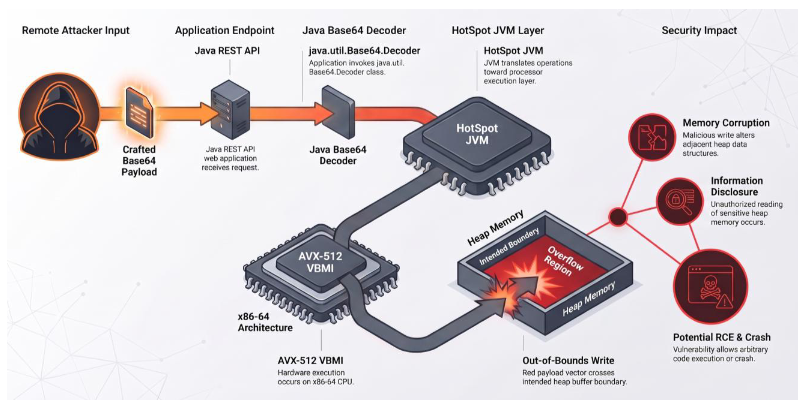
Among the vulnerabilities, CVE-2026-114938, publicly referred to as Java4Shell, affects the Java Virtual Machine's optimized Base64 decoding functionality. The vulnerability involves a heap-based memory-corruption condition in the AVX-512 accelerated execution path. An unauthenticated remote attacker may exploit the flaw by supplying specially crafted Base64 data to an affected Java application running on a compatible x86-64 processor.
Successful exploitation may result in arbitrary code execution within the context of the affected Java process, memory corruption, sensitive information disclosure or application service disruption.
The vulnerability is particularly relevant to Java-based web applications, API services, enterprise middleware, transaction-processing systems, government portals and containerized workloads.
Considering the extensive use of Java-based technologies in Bangladesh's government and financial-sector infrastructure, organizations are strongly advised to identify affected Java runtimes, priorities internet-facing systems and apply the relevant security updates.
Vulnerability Details
Oracle Java SE – November 2026 Critical Security Update
Oracle's November 17, 2026 Critical Security Patch Update addresses 11 newly reported Java SE vulnerabilities.
Key security characteristics:
· 11 new Java SE security patches.
· All 11 vulnerabilities may be remotely exploitable without authentication.
· The highest CVSS v3.1 score in the Java SE risk matrix is 8.1.
· Vulnerabilities affect multiple Java components and supported releases.
· The update also addresses vulnerabilities affecting Oracle GraalVM and JavaFX.
Technical description
CVE-2026-114938 is associated with a memory-corruption vulnerability in the Java standard library's Base64 decoding implementation.
The affected functionality is associated with the java.util.Base64.Decoder implementation and the HotSpot JVM's optimized Base64 decoding intrinsic.
On compatible x86-64 processors, the JVM may use an AVX-512 VBMI accelerated code path to process Base64 data. Specially crafted input supplied to an application that decodes attacker-controlled Base64 data may trigger an out-of-bounds memory write in this execution path.
Because the vulnerability exists within the Java runtime rather than a specific third-party application library, multiple applications using an affected runtime may be exposed.
Conditions relevant to exposure:
· The application uses an affected Java runtime.
· The runtime executes on a compatible x86-64 processor with AVX-512 VBMI support.
· Attacker-controlled data reaches the affected Base64 decoding functionality.
· The vulnerable decoding path is selected during execution.
Reported affected environments include OpenJDK 17.0.6 and later, with additional Java releases identified in technical research. Exact applicability should be confirmed against the relevant vendor advisory and fixed-build information.
ARM64 environments and x86-64 processors without the required AVX-512 VBMI capabilities are not known to be affected by this specific execution path.